If your employer has asked for a pre-employment medical check-up, the short answer to "what happens?" is: a short history and physical examination, some basic measurements, and a set of tests that depends entirely on what the employer or the relevant authority requires. Most people are in and out within an hour, and results typically come back within a few working days depending on which tests are ordered. What varies most is the test list — a general office role, a food handler, an offshore or industrial worker and a foreign worker permit application are not the same requirement. This guide covers what is usually involved and how to avoid the delays that catch people out.
This is general information about the process. Your own requirements depend on your employer, your role, and the applicable authority.
Why employers ask for one
A pre-employment medical is not there to catch you out. Its purposes are usually practical:
- To confirm you are medically fit for the specific demands of the job
- To establish a baseline record before you begin, particularly for roles with occupational exposures
- To meet statutory or licensing requirements for certain industries
- To meet immigration requirements for foreign workers
Certain roles have specific health requirements set by regulation — food handling, work at height, confined spaces, driving heavy vehicles, offshore work and healthcare roles among them. If you are unsure which category you fall into, ask your employer for the exact form or test list before booking.
What is usually included
Most standard pre-employment medicals cover:
History and examination
- Past medical and surgical history, current medications, allergies
- Family history and lifestyle, including smoking and alcohol
- Occupational history for relevant roles
- Physical examination: heart, lungs, abdomen, and a general check
Basic measurements
- Height, weight and BMI
- Blood pressure and pulse
- Vision, often including colour vision for certain roles
- Sometimes hearing
Common tests
- Full blood count
- Urine test
- Chest x-ray, commonly required
- Blood glucose and sometimes a lipid profile
- Additional blood tests as specified by the employer or the relevant authority
Role-specific additions
- Lung function testing for dust or fume exposure
- Audiometry for noisy environments
- ECG for some roles or age groups
- Screening tests specified by immigration or industry regulators
Not every employer asks for everything on this list. Bringing the employer's own form to the appointment is by far the most reliable way to make sure nothing is missed.
How to prepare
A few small things prevent a repeat visit:
- Bring the employer's form or requirement letter. Without it, the clinic is guessing.
- Bring identification — IC or passport — and a passport-size photo if the form requires one.
- Ask whether you need to fast. Some blood tests, particularly lipid profiles and fasting glucose, require it. Confirm with the clinic when booking.
- Bring a list of your current medications, including supplements and traditional medicines.
- Bring records of past conditions or surgery if relevant, and any recent test results.
- Bring your vaccination record if you have one.
- Tell the clinic if you may be pregnant before any x-ray is taken. This matters.
- Wear something easy to change out of, and avoid metal jewellery if a chest x-ray is planned.
- Do not skip your regular medication unless a doctor tells you to.
Being tired, dehydrated or rushing straight from a long drive can skew blood pressure readings. Arrive a little early and sit for a few minutes.
How long results take
The examination itself is usually under an hour. Results depend on the tests:
- Basic measurements and examination — the same day
- Routine blood and urine tests — commonly a few working days
- Chest x-ray reporting — varies by clinic
- Specialised or authority-processed tests — longer, and outside the clinic's control
If you are working to a start date or a visa deadline, tell the clinic when you book. That single sentence prevents most of the panicked follow-up calls we receive.
What happens if something is abnormal
This is the part people worry about most, and usually more than they need to.
An abnormal result is not automatically a failed medical. In practice:
- Borderline results are common and often need nothing more than a repeat test. A slightly raised blood pressure or blood sugar after a poor night's sleep or a heavy meal happens frequently.
- The doctor will explain what the finding means and whether it is relevant to the role you applied for.
- Many findings are unrelated to fitness for work. They are simply useful for your own health, and may lead to a follow-up appointment with your family doctor.
- Some findings need further assessment before a fitness opinion can be given, which may mean repeat tests or a referral.
- A small number of findings genuinely affect fitness for a specific role — commonly around vision requirements, lung function in dusty work, or conditions that make particular tasks unsafe.
Your results are confidential medical information. What is shared with an employer is normally the fitness opinion required by the form, not your full clinical record. If you are unclear about what will be disclosed, ask the clinic before the examination — you are entitled to that explanation.
Common reasons a medical gets delayed
From what we see at the counter:
- Arriving without the employer's form, so the wrong tests are done
- Not fasting when the form required a fasting sample
- Missing identification or photos
- Booking too close to the start date, leaving no room for a repeat test
- Not mentioning existing conditions or medications, which then need clarification later
- Not declaring possible pregnancy before an x-ray
Use it as a health check, not just paperwork
Most people treat a pre-employment medical as a form to be stamped. It is worth more than that. For many adults it is the only time in years that blood pressure, blood sugar and cholesterol get measured at all — and conditions like raised blood pressure and raised blood sugar usually produce no symptoms until they have been present for a long time. Our guides on why blood pressure needs checking even when you feel fine and which annual screening tests are actually worth doing go into what those numbers mean.
Ask for a copy of your results, keep it, and bring it to your family doctor. That copy becomes the baseline that makes every future check more useful.
What affects the cost
We do not publish fees, because the total depends on which tests your employer requires. The main factors:
- The number and type of tests on the employer's form
- Whether imaging such as a chest x-ray is required
- Whether specialised testing such as lung function or audiometry is included
- Any authority-specific processing or forms
- Whether repeat tests are needed
Send the clinic a photo of the form over WhatsApp and ask for an estimate before you come. That is the quickest way to get an accurate answer.
Book with a Mediwira clinic
Mediwira Medical clinics carry out pre-employment and routine medical examinations, complete employer forms, and arrange the tests required for the role. If you have the employer's requirement list, send it ahead and we will tell you what to prepare and whether you need to fast.
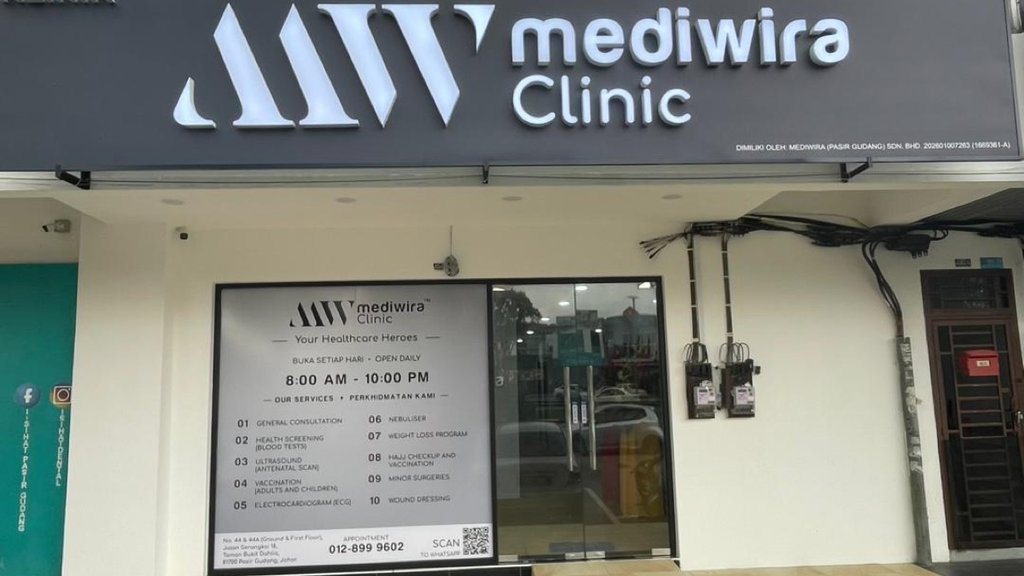
You can find locations such as Mediwira Clinic Pasir Gudang on our clinics page. Each clinic's phone number is also its WhatsApp line — message us to check requirements or book a slot.